
Glass TA

A Kraken trading bot with the risk rules built in

Stop missing moves and stop staring at charts — your rules run around the clock.

Built for self-directed Kraken traders who want their entries, exits and risk caps enforced the same way at 3am as they'd write them on paper. Glass TA Command Center runs a fleet of technical-analysis bots on Kraken pairs. It scans EMA structure, stages every position through a risk governor, marks open trades to market on a schedule, and keeps live trading locked behind an explicit confirmation.

Spot only, long-only, no leverage — not for derivatives traders or set-and-forget promises.

Automated trading can lose money. No returns are guaranteed.

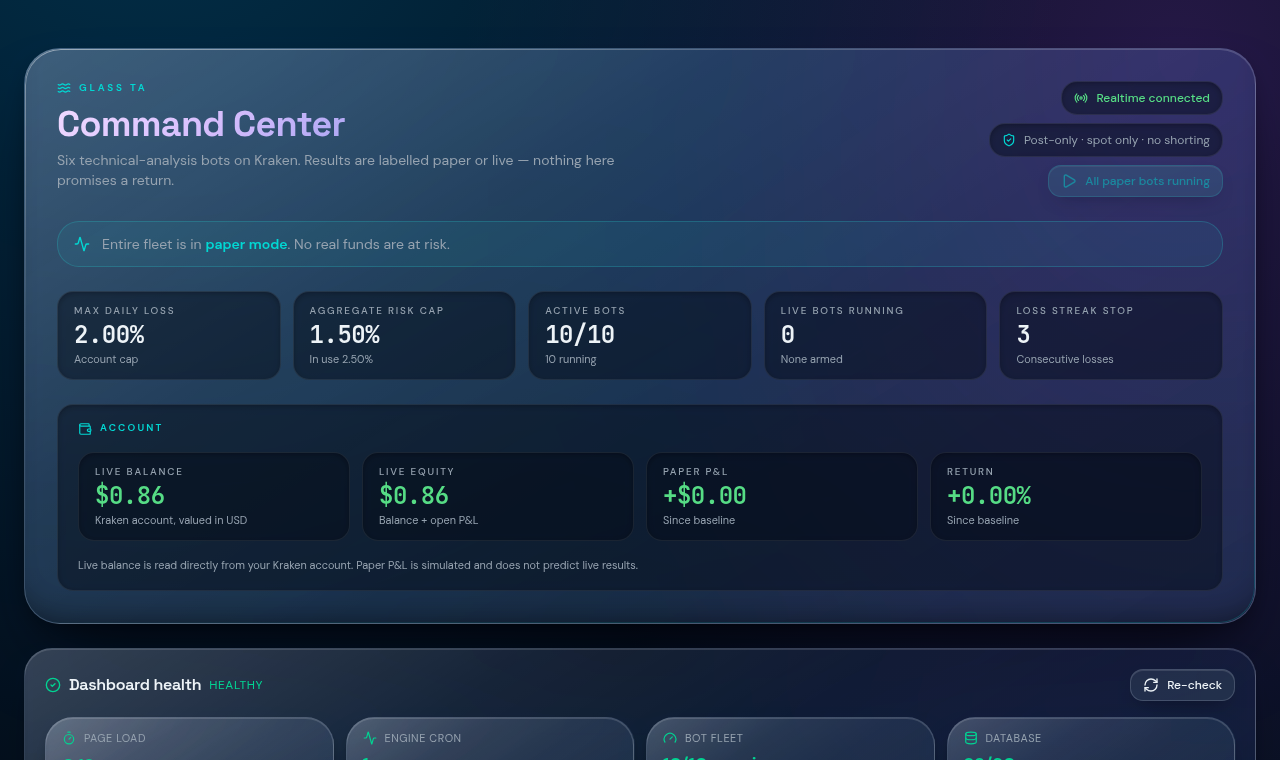
Glass TA Command Center dashboard in paper mode: risk caps, account balance, paper P&L and fleet health for a 10-bot Kraken fleet
The real dashboard in paper mode — risk caps, account value and fleet health at a glance.

Free to use. 10% of profit, only when you win.

No subscription. We take 10% of new live trading profit above your best-ever result (high-water mark), paid from a small prepaid reserve in USDC or USDT on Solana. Your trading money never leaves your own Kraken account, and the keys you connect cannot withdraw.

A $29/month subscription costs $348 a year before you make a trade. Glass TA costs nothing until your live trading passes its best-ever result — then 10% of the new profit.

The fee math on a small account

The 4-hour paper fleet has closed 23 trades since Aug 3, 2026 — about 1 to 2 round trips a week. At Kraken's lowest tier, taker fees plus slippage cost about 1.8% per round trip, so a $500 position pays Kraken roughly $9 each time. That goes to Kraken, not to us.

Our 10% only applies to profit above your high-water mark: a $50 gain costs $5, a $150 gain costs $15, and a flat or losing week costs $0. Compare that with a fixed $348 a year whether you win or lose.

Read the full fee and data terms

  • No fee on losses or on winning back losses
  • Trade-only API keys, withdraw disabled
  • Start with a $5 reserve; top up any time

What paper-mode testers say

No tester stories yet — the first paper-mode testers are running the fleet now. Their own words go here, first name and what they actually saw, small numbers included. Nothing here is written by us.

What the paper fleet has done so far

Real simulated results from the fleet's own paper trading, updated monthly. Snapshot of Nov 8, 2026 · fleet running since Aug 3, 2026.

Closed paper trades
23
Win rate
83%
Average result
+0.89R
Best trade
+2.67R
Worst trade
-1.00R
Paper test bots created
42
Accounts signed up
6

Paper results are simulated against live Kraken prices with no slippage or fees modelled. The worst trade is -1.0R by design — that is the protective stop doing its job. Simulated results do not predict live results. Bot and account counts taken from our own records on 2026-11-09; the account count includes mine.

Gianni Mazzei, founder and operator of Glass TA

Who is behind this

Glass TA is built and operated by Gianni Mazzei. I trade on Kraken myself and got tired of bots that charge a subscription whether they win or lose. So I built the one I wanted: it trades from my own Kraken account with keys that cannot withdraw, enforces my risk caps mechanically, and only gets paid when I make new profit.

Why I built this · What I write about

What I shipped this week

  • Fee deposits now only count if they carry your own GTA memo, so nobody can claim your transfer.
  • Scan-to-pay QR for the fee reserve: Phantom or Solflare fills in the address, amount and memo.
  • “Get started free” now opens Create account instead of Sign in.
  • Sign-in links can no longer send you to another website.
  • Security headers on every page.
  • Your keys are stored server-side; we never see your card or your Kraken password
  • We do not sell your data
  • Fee deposits are USDC or USDT on Solana, checked against the public Solana ledger

Verified elsewhere

No outside reviews or listings yet — Glass TA is new. When a review profile or public listing goes up, it shows here with the date it went live. Until then, the one thing you can check without trusting us: every fee deposit is on the public Solana ledger.

The strategies the bots use

Fleet standard

Hybrid: 3-Wave Retracement + EMA Trend

In plain English: buy the dip early in a new uptrend, never chase a move that has already run.

Every bot reads the 4-hour chart. First it looks for a 3-wave pattern and only buys pullbacks during wave 1 or wave 2 — never chasing wave 3. A bullish RSI divergence raises confidence. When no wave setup exists but all moving averages line up in an uptrend, it falls back to buying a dip toward the 21-period EMA. Long-only: no shorting.
Exits

Tiered 4-hour ATR trailing stop

In plain English: the stop loss only moves up, locking in more profit the further a trade runs.

Each trade starts with a protective stop. At +1R the stop moves just above entry, at +2R it trails 1.0× the 4-hour ATR, and at +3R it widens to 1.5× ATR so strong moves can keep running. The stop only ever moves up, on closed candles.

Optional

Spot 5% target ladder

In plain English: bank most of the gain at +5% and let a small piece keep riding.

A spot strategy aiming for a 5% move: stop tightens at +1.5% and +3%, trails 1% from the peak at +4%, then banks most of the position at +5% and lets the rest ride an ATR trail.

Module

EMA Channel multi-agent engine

In plain English: five independent checkers must agree before a trade is allowed.

Six EMAs plus regression channels are scored by five independent agents. A trade needs their consensus, a good reward-to-risk, and an entry low enough in the channel.

What the bot actually does

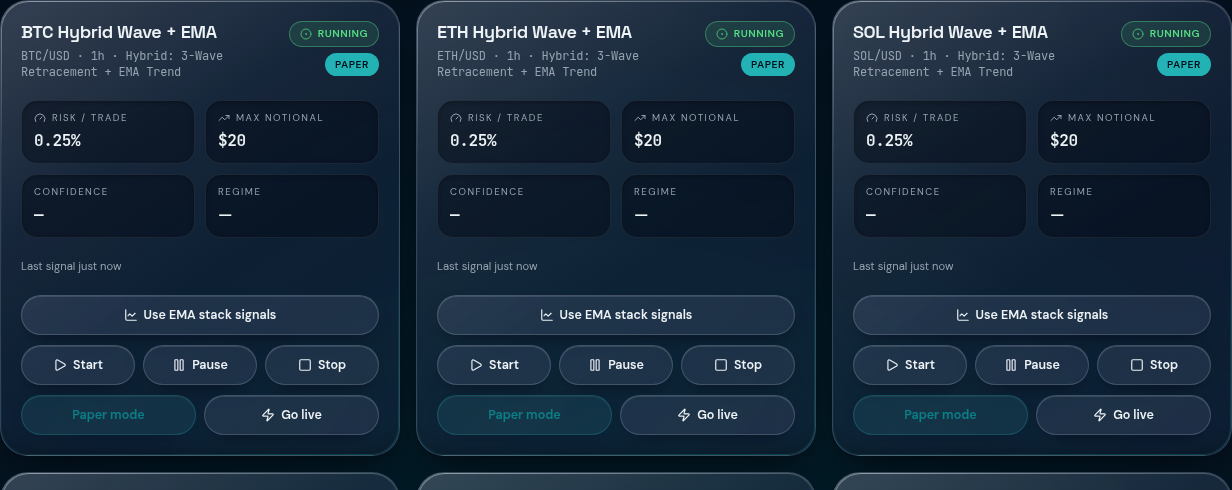
The bot fleet panel: BTC, ETH and SOL hybrid wave bots running in paper mode with per-bot risk caps, max notional and start, pause, stop and go-live controls
Every bot runs with its own risk cap and an explicit paper-to-live switch.

EMA-structure scanner

Kraken OHLC candles are pulled per pair and scored against a stacked EMA ruleset. Only aligned structure produces a signal, and each rejection is logged with its reason.

So you stop staring at charts waiting for a setup.

Staged position governor

Entries start at 50% of the risk budget and scale in at +0.4R and +0.8R only when independent signals agree. Losing positions are never pyramided.

So a losing trade can never talk you into doubling down.

Hard risk rules

Aggregate stop-risk is recalculated after every add, the original risk budget is never exceeded, and adds are blocked when spread, volatility or liquidity deteriorate.

So your risk cap is enforced at 3am exactly as you wrote it.

Trailing exits you can see

Open trades render as live orbs that glow with unrealized P&L, move along an R-multiple axis, and switch to ATR trailing once the trade clears +1.5R.

So a winning trade stops round-tripping back to a loss.

Manual override

Take profit now at the current marked price, stop a bot, or close a stale position without waiting for the scheduled cycle.

So you can always step in and take the win yourself.

Guarded live switch

Keys are stored server-side, a preflight dry run checks the execution path, and long-only mode stops spot sells for assets you don't hold.

So going live is a deliberate decision, never an accident.

How it works

  1. 01

    Create an account

    Sign up and a 10-coin hybrid fleet (BTC, ETH, SOL, XRP, ADA, DOGE, LINK, AVAX, NEAR, TAO) is created in paper mode, switched off until you start it.

  2. 02

    Pick pairs and strategy

    Assign Kraken pairs to each bot, choose the EMA lengths, and set risk caps, cooldowns and the maximum trade age.

  3. 03

    Watch paper results

    Signals, orders, open trades and closed-trade P&L all stream into the dashboard so you can judge the rules before funding anything.

  4. 04

    Connect, agree, fund

    Connect Kraken keys (no withdraw permission), accept the 10% profit-share terms, and send a small USDC/USDT deposit on Solana to your fee reserve.

    Read the profit-share terms before you agree

It keeps running with the browser closed

Signal scanning, mark-to-market, Kraken order reconciliation and stale-trade expiry all run server-side on a schedule. When you reopen the dashboard you see what the fleet did while you were away, including auto-closed trades and realized P&L.

  • Scheduled scanner with per-pair cooldowns
  • Order status polled until filled or canceled
  • Take-profit tolerance so targets don't get missed

Kraken trading bot FAQ

What is a Kraken trading bot?

Software that reads market data for Kraken pairs, applies a rule-based strategy, and places orders through the Kraken API instead of you clicking manually. Here the rules are EMA-structure signals with a risk governor on top.

Can I test it without risking money?

Yes. Every bot starts in paper mode against a simulated balance. Live trading stays blocked until you connect Kraken API keys and pass an explicit confirmation step.

What happens if my fee reserve runs out?

New trades stop opening — that is the whole effect. The bots keep managing and closing positions you already have, and your Kraken balance is never touched. Top up the reserve (from $5 in USDC or USDT on Solana) and entries resume automatically.

Do I need to understand R-multiples and ATR to use this?

No. R just measures profit in units of what you risked — +2R means you made twice your risk. ATR is a standard measure of how much a coin typically moves, used to place the trailing stop. You set a dollar risk cap per trade; the bots handle the rest.

Do I need to keep the browser open?

No. Scanning, marking, reconciliation and expiry run on a server-side schedule.

Does it guarantee profits?

No. Automated trading can lose money. This is a control surface for your own strategy and risk limits, not a promise of returns.

Run your first paper fleet tonight

Create an account, assign Kraken pairs, and watch the signal feed. Live trading is opt-in and always requires a confirmation.